










Why Wandeli
Builders’ merchants now stock an ever wider range of tiles. These materials are often hard and brittle and need the right equipment to process them. There is a fairly wide choice of professional tools and machines on the market, but not all of them meet the requirements and expectations of tilers.
It is often the case that when looking for a professional machine to cut tiles up to 20 mm thick, you face a difficult choice:
-
Buy a machine designed more for cutting thick stone, paving blocks, etc. And when you buy it, you immediately get the “bonus” of bulk and weight.
-
Or buy a machine for a smaller blade diameter, intended more for DIY use or for tradespeople who are just starting out with tiling.
As a distributor of professional power tools and diamond tools, we talk to many tilers every day about the problems they have when cutting tiles on electric tile saws, such as:
✔ Blade drifting off the cutting line
✔ Tiles cracking when cutting to size
✔ Problems mitring porcelain stoneware
✔ Cut running off in an arc
✔ Hard to achieve a high-quality cut
✔ Does not hold dimensions, etc.
We will look at the possible causes of these problems, which Wandeli tile saws do not suffer from.
Blade diameter
Most of the popular electric tile saws on the market are designed for blades from 200 to 250 mm in diameter; saws for 180 mm blades are less common. There is a noticeable tendency to regard saws designed for larger blades as more professional, and vice versa. This is exactly where one of the problems lies, because the larger the blade diameter, the lower its rigidity, and vice versa. The larger the blade diameter, the harder it is to eliminate blade wobble.
The manufacturer of Wandeli tile saws takes a different view of tile processing and maintains that a tiler does not need a large blade diameter to cut thin tiles. For these tasks a diameter of 115-125 mm is entirely sufficient, the same as on most angle grinders, because a 125 mm blade on a Wandeli machine cuts through 30 mm of material with ease.
Rail design
With mitring problems, as with straight cuts, the cause may lie not only in the blade diameter but also in the design of the rail. Looking at the saws on the market, you will notice that manufacturers take different approaches to the guide system. Some use metal rollers, others have plastic rollers running on an aluminium guide rail, others again have rollers running on the outside or inside of the rail; some have more rollers, some fewer, some have done it better, some worse, but practically every manufacturer shares one problem. During work, dust, of which there is more than enough on a building site, gets into every system and over time wears the guide components. This shows up as play developing in the most frequently used spots as the softer material wears. With a worn rail, the machine cannot even be calibrated. This is what causes problems with mitring and more, because even minimal play in the rail makes a perfect cutting line impossible. Not even the best blade designed for the job will make up for it.
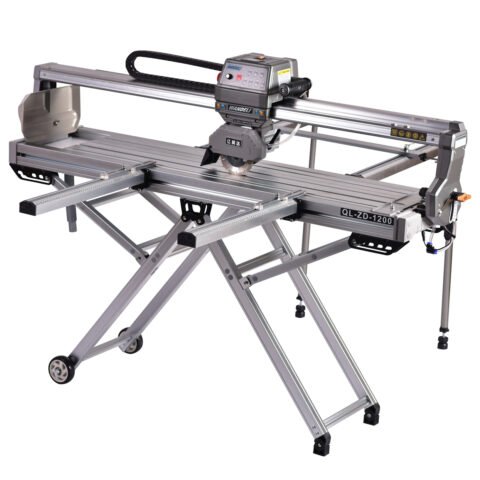
The rail design of Wandeli machines is completely different, unlike anything else on the market! Bearing-steel rods are pressed into the aluminium rail, and four bearing-steel rollers mounted on bearings run along them. All of this is protected by a special film on the inner side (facing the table), which stops the guide rollers from getting dirty. Combined with a small, rigid blade, this design ensures extremely precise cutting, both straight and at an angle.
Calibration and adjustment
Sometimes you buy an expensive blade for your machine and expect a high-quality, chip-free cut (that is precisely what sets a wet tile saw apart from an angle grinder: the quality of the cut), only to find that the expensive blade is no better than a cheaper one. The problem may not lie in the blade at all, but in the calibration of the machine, specifically the parallelism of the blade plane to the guide rail. Even a small deviation can cause the front of the blade to cut perfectly while the back lifts (chips) one edge of the tile. Not every saw can be calibrated by the user without sending it in for servicing, and most machines have no such option at all!
Every Wandeli machine can be calibrated and adjusted by yourself in a few minutes, right on site, using only the spanners supplied! On every machine almost everything can be adjusted: the laser lines or angle, the parallelism of the rail to the table, the parallelism of the blade to the rail, the angle (which can be increased beyond 45 degrees), the table height and the sensor point at which you want the head to slow down.
Simple, reliable guidance!
WANDELI tile saws: precision, precision and more precision!
Aluminium body
Many electric tile saws have a problem with the durability of the body and rust quickly. No wonder, since most of them are made of ordinary sheet steel with a single thin coat of paint, and even when the paint is applied well, repeated cleaning of the water tray simply wears it down to bare metal. Of course, tradespeople who look after their equipment and service it regularly can extend the life of the body. But that takes a lot of time that could be spent in any number of more enjoyable ways.
Every Wandeli machine has a body made entirely of aluminium, which, together with stainless steel mounting bolts and washers, protects the machine against rust throughout its service life.
Weight and portability
Today, the weight of an electric tile saw is crucial. Many tilers work alone, and jobs are not always in detached houses where you can ask someone to help with loading or unloading. Often they are blocks of flats where, for one reason or another, the lift is out of order, machines are not allowed in it and you have to carry everything up the stairs. Some saws are so heavy that even with a helper, carrying one up to the nth floor becomes quite a problem, and with the small rooms in flats there is often nowhere to put such a large machine. That is why many of you have machines gathering dust in the garage. Some take tiles to that garage to be cut, some to a colleague, some to a Water Jet, which unfortunately is not easy. Some give up on wet saws altogether and increasingly choose an angle grinder, with or without a guide, which of course makes the work easier, but not always. You often come across types of tiles that can be cut only wet.
Wandeli tile saws change this, because, as we wrote above, they are made of aluminium and are so light and portable (some models weigh less than a large toolbox) that any tradesperson can load, unload or even carry the machine upstairs on their own without difficulty.
A Wandeli machine after two years of service, clearly not used gently, and zero rust!
The Wandeli QX-800, which cuts up to 900 mm, weighs only 28 kg.
Wandeli machines don’t rust!
Wandeli machines look after your back!
Power and speed
Looking at the popular machines on the market and their motor specifications, you will notice that motor power is usually around 900-1100W and speed ~2700-3000 rpm, with blade diameters of ~200-250 mm.
All Wandeli machines are fitted with “KYNKO” motors rated at 1550W and 12000 rpm, power and speed designed for 115-125 mm blades! With these specifications, no tile is a challenge for a Wandeli machine, be it ceramic, porcelain stoneware, terrace tiles or natural stone slabs. The machine effortlessly cuts these materials up to 30mm thick in a single pass, and some tilers cut several tiles at once, stacked on top of each other!
Dry and wet
Practically every wet tile saw is designed for wet cutting only. Blades from 180 mm in diameter designed for dry cutting of tiles are either unavailable on the market or offered in too small a range.
With a Wandeli tile saw you have no limitations: you can work dry as well as wet, and the machines take all angle grinder blades of 115 and 125 mm. Even if the pump burns out, you can always finish the job while waiting for a new one!

