









Which Tile Suction Lifter to Choose? Smooth, Textured and Large-Format Porcelain

A tile suction lifter is chosen according to the surface of the material, its size and the way it will be carried. The maximum load printed on the tool alone is not enough to judge whether it is suitable. With smooth porcelain stoneware, quick gripping may matter most, while on a textured surface the ability to keep a tight seal is key. Before buying, you also need to separate three tasks: carrying the tile, positioning it and bedding it into the adhesive.


Manual or automatic suction lifter?
A simple lever suction cup is a solution for surfaces on which its seal can adhere properly. Do not assume it will work equally well on a pronounced texture. In a model with a hand pump, the operator creates the vacuum and monitors whether it holds. Depending on the design, this is shown by a pressure gauge or an indicator on the plunger. An automatic suction lifter uses a powered pump, and models with a suitable control system top up the vacuum when it drops. Automation reduces the need for manual pumping, but still requires supervision by the operator.
Why does the porcelain stoneware surface matter?
The seal must enclose the area from which the device removes the air. Dust, dried adhesive and irregularities at the edge of the seal can cause a loss of vacuum. That is why both the tile surface and the working part of the suction lifter must be cleaned before use. A tool described as intended for textured porcelain stoneware will not necessarily cope with every depth of relief or every degree of porosity. Test the suction on the specific tile before you start carrying it. If the pump runs unusually often or the vacuum reading drops, set the piece down safely and find the cause.
BIHUI SCBLVT: a solution for narrower pieces
The BIHUI SCBLVT has an elongated base measuring 240 × 100 mm. The product page states a minimum tile width of 105 mm, which is useful information for cut strips. The stated maximum load is 120 kg, and the tool has a digital display and automatic vacuum control. The description provides for use on smooth and textured surfaces. When choosing it for a particular strip, also check its length and whether there is room to rest the whole seal on it. A narrow housing will not help if part of the seal ends up beyond the edge of the material.
WERTEC WTPP200AG: a round suction lifter for a larger gripping area
The WERTEC WTPP200AG has a diameter of 200 mm and is described as a model for smooth and textured tiles. The product page gives a maximum load of up to 190 kg. The device has a pressure gauge and a system that automatically tops up the vacuum when it drops. This model is worth considering when the tile offers a large enough area for the round base. However, the difference between the 120 and 190 kg ratings should not be treated as a simple comparison of safety in all conditions. Check the permissible load for the position and surface type specified in the instructions for the tool in question.
SENDI ELLIPSE: pay attention to the vertical load
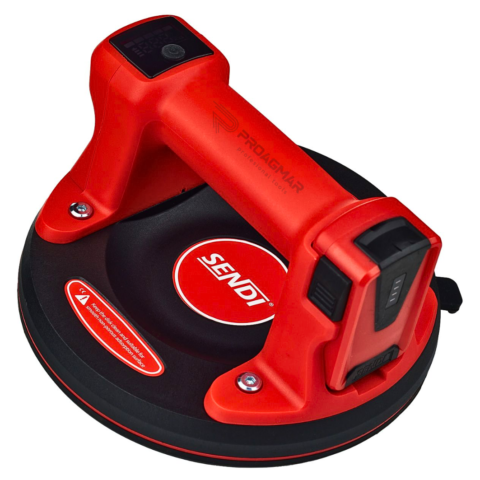
The SENDI ELLIPSE has an oval base measuring 130 × 200 mm and automatic vacuum maintenance. The description provides for use on dry smooth and slightly textured surfaces. This is an important limitation that should not be extended to every deep relief on porcelain stoneware. The product page lists a maximum safe load of 100 kg and a maximum vertical load of 60 kg separately. This is exactly why you need to know the position in which the tile will be carried when choosing a suction lifter. The digital display lets you monitor the vacuum and the battery status, and the weight of the device given in the specification is 0.95 kg. For narrow strips, compare the base width of the SENDI ELLIPSE with the BIHUI SCBLVT and choose the model whose seal fits entirely on the material.
Suction lifter load capacity and carrying a slab safely
Carrying vertically and lifting horizontally can mean different load conditions for the seal. A jerk or a sudden change of position increases the risk of losing grip. Two suction lifters with the same load capacity do not automatically make a set with twice the permissible load. With large, thin slabs, the deflection of the material between the support points also matters. Such tasks may require a suitably chosen transport frame and more than one person. A manual suction lifter must not be treated as lifting equipment unless it has been expressly approved for that purpose.
A vibrating suction lifter does a different job
Vibrating models such as the BIHUI LFTBS or WERTEC WT888 are primarily used to help bed tiles into the adhesive. Their function should not be equated with the carrying done by any vacuum suction lifter. Vibration can help bed the tile, but it will not fix a poorly prepared substrate or incorrectly spread adhesive. The effectiveness of bonding must also be assessed by checking the coverage on the back of the tile. For narrow pieces, compare the geometry of the SENDI ELLIPSE and BIHUI SCBLVT; for a larger available gripping area, consider the WERTEC WTPP200AG. Before ordering from PROAGMAR, state the format, weight, surface texture and method of carrying, so that you choose a suction lifter for the task and not just for the number on the label.