









Which Manual Tile Cutter to Choose and Why? SENDI, BIHUI or WERTEC

A manual tile cutter is particularly useful where fast, repeatable straight cuts are what counts. It needs no power supply or water feed, and the scoring and snapping process itself does not produce the cloud of dust typical of dry cutting with a blade. Its effectiveness, however, depends on the type of tile, a scoring wheel in good condition and the stability of the whole frame. That is why your choice should start with the materials and formats you actually work with.
How does a manual tile cutter work and what are its limitations?
The scoring wheel makes a controlled score in the surface of the tile, after which the breaker starts the snap. Unlike a diamond blade, the tool therefore does not cut through the full thickness of the material. The right starting point is usually a single continuous score with even pressure, in line with the recommendations of the cutter and tile manufacturers. Running the wheel over the same line several times can make the score worse. Tiles with a deep texture, internal stresses or a difficult glaze may need test cuts and a different processing method. A manual tile cutter is also no substitute for the proper tools for holes, internal cut-outs and grinding corners.
How do you choose the cutting length?
For cuts parallel to the edge, what counts is the length of the guided score. A diagonal cut needs a longer range. A 60 × 60 cm square has a diagonal of about 84.9 cm, so a cutter with a 600 mm range cannot handle that cut. For a 90 × 90 cm tile the diagonal is about 127.3 cm. With its 1300 mm range, the BIHUI TCK 1300 covers this length geometrically, but before buying you still need to check that the tile and the measuring stop can be positioned stably. With a 1200 mm range, the WERTEC BISON CUT 1200 will be too short for the full diagonal of such a square.
BIHUI TCK 1300: when is the longer model worth choosing?
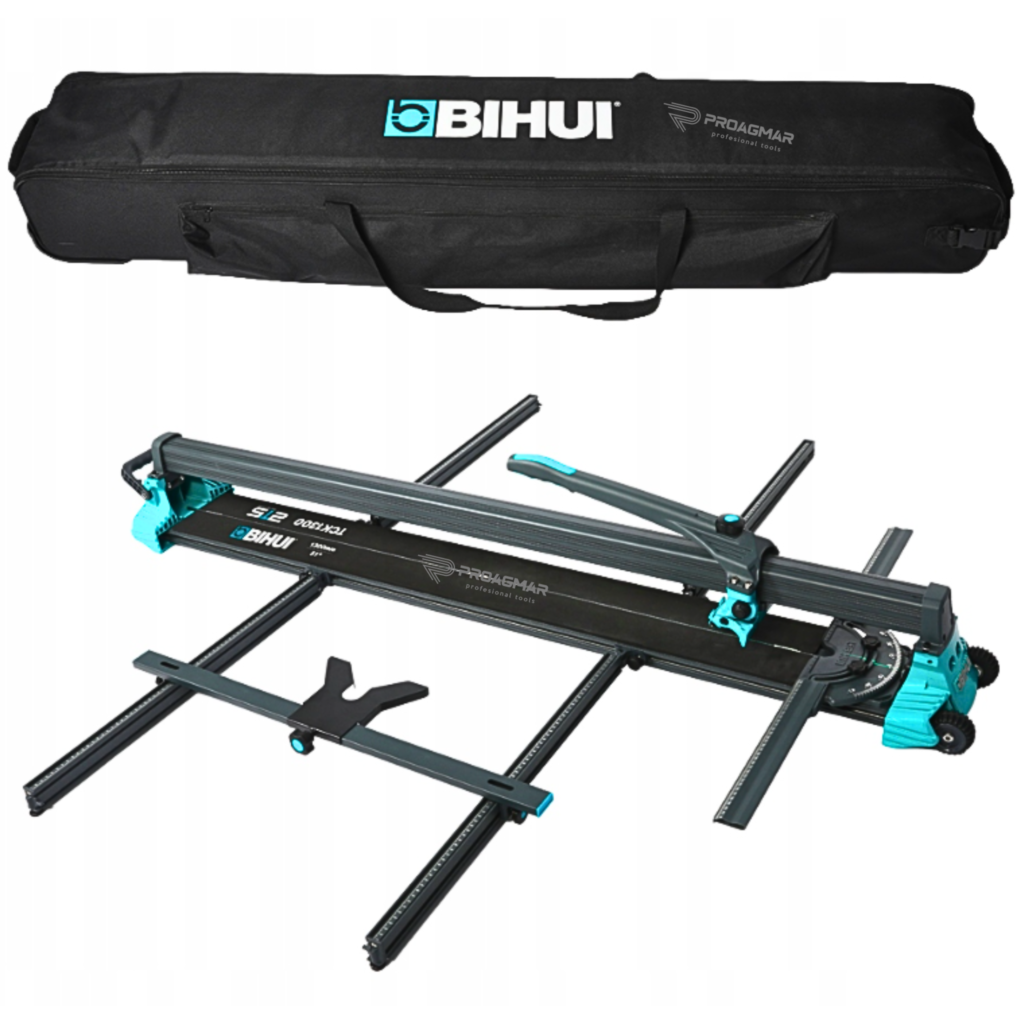
The BIHUI TCK 1300 is aimed at contractors who need a 130 cm range and extensive material support. The product page lists four side supports with adjustable feet and two breaking points. The stated tile thickness range is 3 to 20 mm. This does not mean, however, that every 20 mm porcelain stoneware tile will snap cleanly regardless of its structure. With material like this, a test on the actual tile is particularly valuable. The green laser helps with setting out the line, but repeatability still depends on the guide geometry, the base and a correctly set measuring stop.
WERTEC BISON CUT 1200: when everyday portability matters
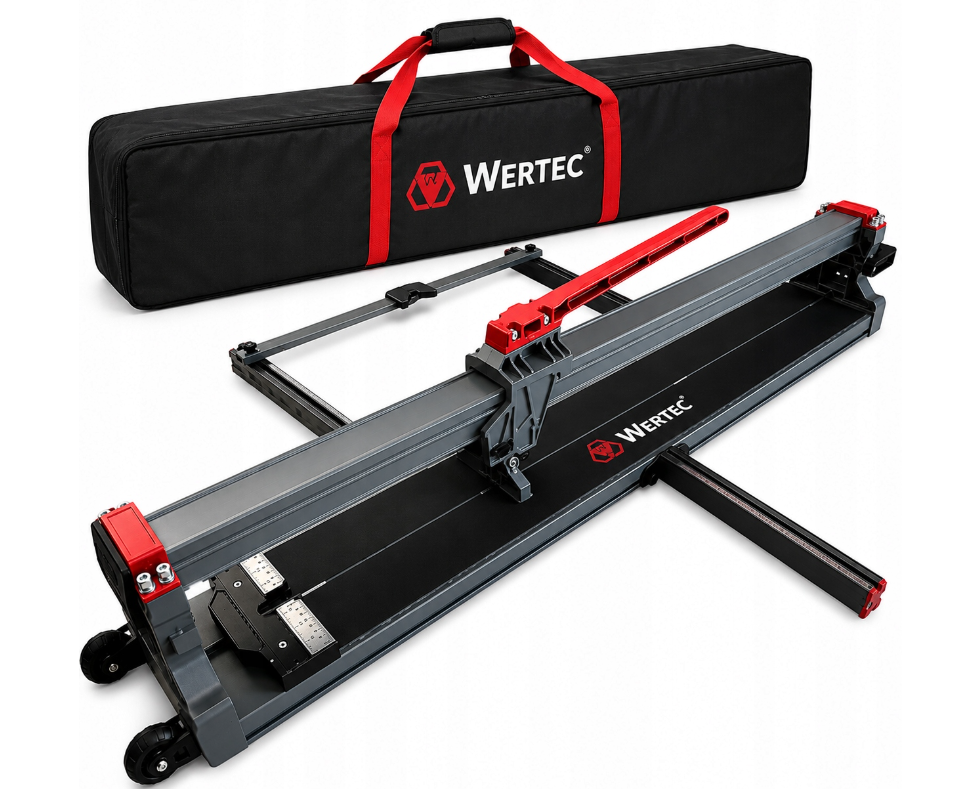
The WERTEC BISON CUT 1200 is worth considering for work within a 120 cm range and when the equipment is transported frequently. The description gives a net weight of 14.8 kg, four breaking points and a bag included in the set. The stated material thickness range is 6 to 14 mm. This is a significant difference from the range given for the BIHUI TCK 1300. If you usually work porcelain stoneware within these limits, you do not need to choose a larger machine just for headroom on paper. If, however, you plan to work thicker material or longer cutting lines, check the limits of the specific model first.
SENDI PROCUTTER ULTRA: three breaking points and supports
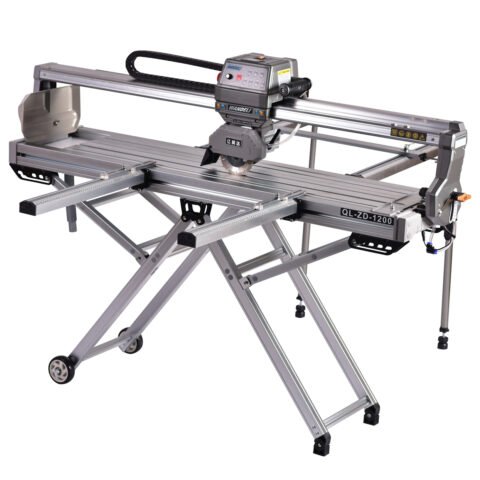
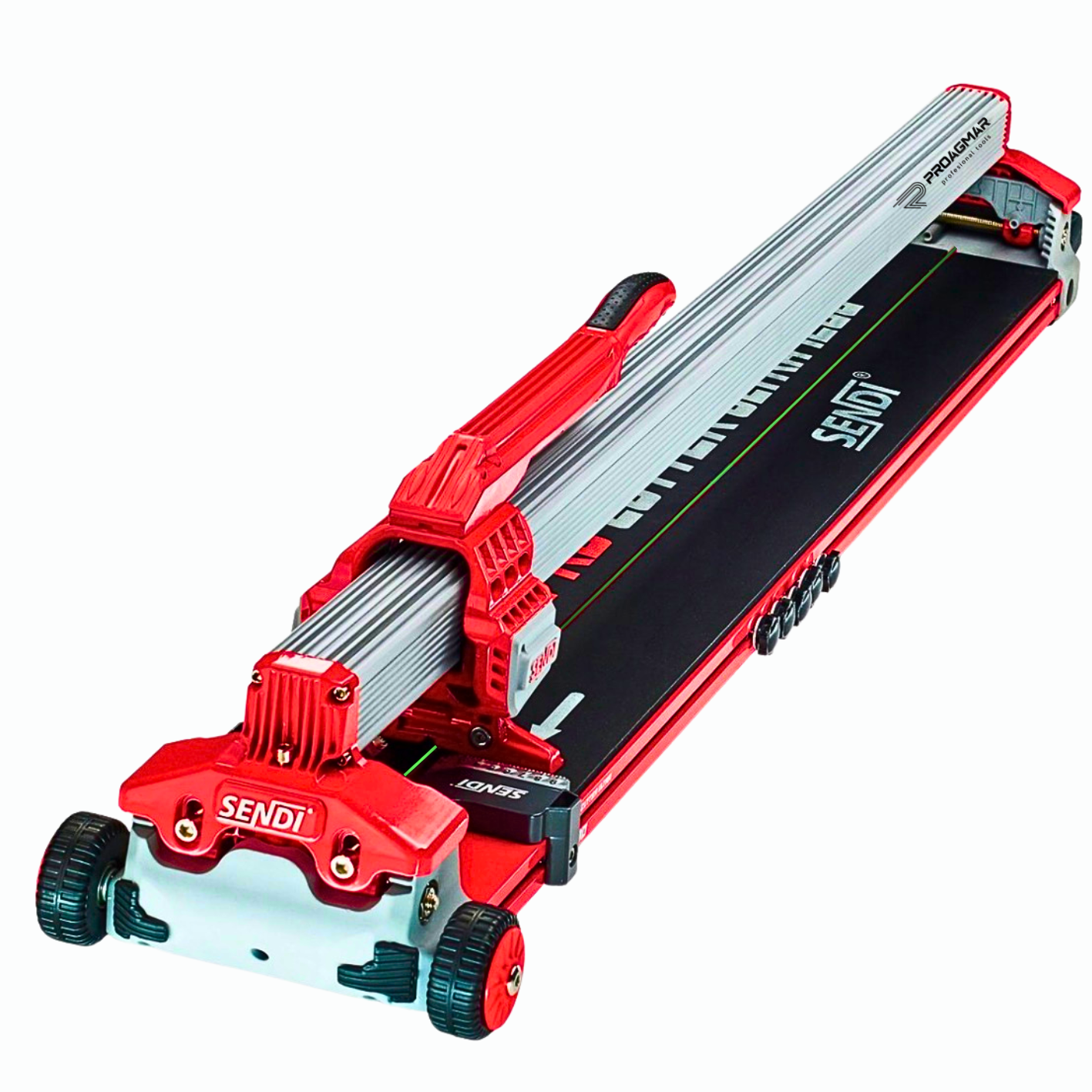
The SENDI PROCUTTER ULTRA 1200 is another model to compare when working with long tiles. The product page gives an actual cutting length of 1220 mm and a thickness range of 6 to 15 mm. The design has three breaking points and three 70 cm side supports. With this equipment, pay attention to how the material can be supported in a given position, especially when cutting off long strips. The green laser helps with setting out the line, and the wheels with a handle make the machine easier to move. The SENDI PROCUTTER ULTRA is worth considering when you need a range of over 120 cm but do not make cuts that require the full 130 cm. For shorter pieces, also check the SENDI PRO CUTTER COMPACT 65 cm, as smaller equipment can be more convenient in a cramped workspace.
Scoring wheel, guide rail and breaker: three parts to assess
The scoring wheel must match the cutter in size and mounting. Even similar-looking parts should not be swapped without confirming compatibility. A worn wheel can leave an uneven score, which pressing harder on the handle will not fix. The carriage should glide smoothly, without noticeable play affecting the direction of the score. The base and supports must hold the tile steadily during breaking. The stated breaking force is only one parameter and does not on its own determine the quality of the edge.
How do you check a tile cutter before the first series of cuts?
Set the measuring stop and compare the width of the cut strip at both ends. Make several test cuts to check repeatability rather than judging the machine by one successful snap. For narrow strips, take into account the limits of the breaker and the manufacturer’s recommendations on the minimum width of the piece being cut off. If the tile breaks away from the score, check the support, the scoring wheel, the scoring technique and the material itself before increasing the pressure. For a wider thickness range and longer cutting lines, compare the BIHUI TCK 1300; for work around 120 cm, consider the SENDI PROCUTTER ULTRA and the WERTEC BISON CUT 1200. At PROAGMAR, choose the cutter together with the right spare scoring wheel, so that a worn small part does not stop work on site.